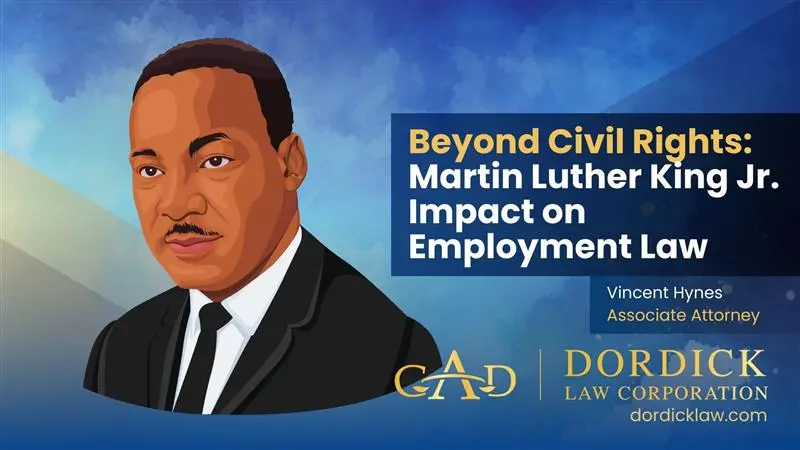
This January 19th, we celebrate Martin Luther King Jr. Day, honoring a leader widely recognized for his role in the civil rights movement whose work also helped shape the legal protections that govern today’s workplace. Dr. King consistently spoke out against discriminatory employment practices and advocated for stronger labor laws, fair working conditions, and employment rights that protect workers and their families.
At Dordick Law Corporation, we recognize that modern employment laws did not emerge by chance. They are the result of decades of advocacy, legal challenges, and efforts to advance workers’ rights, efforts in which Martin Luther King Jr. played an important and lasting role.
The March on Washington and Employment Rights
The 1963 March on Washington is often remembered for its historic speeches, but its full title, The March on Washington for Jobs and Freedom, highlights the movement’s focus on employment rights. Demonstrators called for fair hiring practices, improved labor standards, and stronger enforcement of laws designed to protect workers.
This national demand for employment protections helped drive legislative change and brought workplace rights to the forefront of public policy. Martin Luther King Jr. believed that equal opportunity in the workplace was essential to fairness and dignity. He addressed issues such as discriminatory hiring, unequal pay, unsafe working conditions, and the denial of workers’ benefits, problems that prevented many individuals from fully participating in society.
These concerns remain central to employment law today, where legal protections aim to prevent workplace discrimination, retaliation, wage violations, and the denial of legally mandated benefits.
Influence on Modern Employment Law
Martin Luther King Jr. openly supported labor movements and workers seeking safer conditions and fair treatment. His involvement with the Memphis sanitation workers emphasized the importance of labor laws that protect workers from unsafe environments and unfair employment practices.
Dr. King’s advocacy helped pave the way for the Civil Rights Act of 1964, particularly Title VII, which prohibits workplace discrimination. This legislation remains a cornerstone of employment law, providing legal remedies for workers facing discrimination or unequal treatment.
The Road Ahead
While there has been real progress, employment law violations, like discrimination, wage theft, and unsafe working conditions, still affect workers across many industries, including here in Southern California. Dr. King’s legacy reminds us that employment rights matter and that fairness in the workplace depends on accountability under the law. At Dordick Law Corporation, this day is a reminder of why standing up for workers and protecting their rights remains so important in the communities we serve. This Martin Luther King Jr. Day, we reflect on that legacy and the ongoing work toward equality and justice, for everyone, regardless of race, background, religion, or identity.